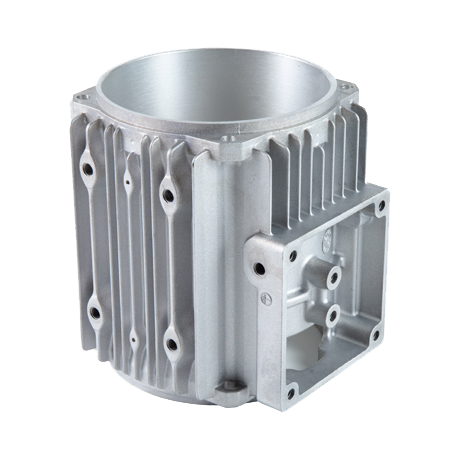
Aluminum alloy motor casing
Finned aluminum alloy motor casing, cast and machined with the mounting faces and bore brought to the assembly dimension.
View product
Grace Metal casts aluminum and zinc parts for OEM programmes, taking a component from CAD review through tooling, trial production and repeat batch manufacturing. aluminum metal casting is the route where weight and stiffness drive the decision, for parts that still have to arrive with excellent dimensional control and a consistent surface finish, while zinc alloy die casting covers thin-wall housings where metal flow and as-cast surface decide the pick. Whichever route is chosen, custom metal components are produced against your drawing, with mold-making and temperature control held to keep every batch uniform and CNC machining and surface finishing run before the parts are packed. This page sets out the process route, what each casting method suits, and what to send with an enquiry.

Six things decide whether a cast component arrives ready for assembly. Each is part of the service rather than an optional extra.
Comprehensive aluminum casting services designed for industrial clients that need durable and highly precise custom metal components, rather than a catalogue part.
The service caters to OEM manufacturing demands from the automotive, aerospace and electronics sectors.
Optimized workflows support reliability and repeatability in high-volume production environments, which is where cast parts usually fail a programme.
State-of-the-art aluminum metal casting techniques are used to achieve excellent dimensional control and consistent surface finishes.
Advanced mold-making and temperature control systems keep the process uniform in every batch, from the first trial shot to repeat production.
Quality checkpoints and CNC machining post-casting enhance accuracy and functional integrity, so the part leaves as a finished component.
The work follows one connected path. Each stage has an output the next stage depends on, which is what makes the quote comparable.
Review the part and the duty it has to survive before any tooling is cut — the service includes design consultation rather than quoting from a drawing alone.
CAD-driven prototyping with iterative feedback loops, so geometry and wall sections are settled on the model instead of in the tool.
Tooling is built for the chosen route, with adaptable tooling that can accommodate different production scales.
Aluminum die casting, zinc alloy die casting or precision casting, run with temperature control to keep batch-to-batch uniformity.
Post-casting CNC machining brings bores, faces and interfaces to the accuracy the assembly needs.
Surface finishing, quality assurance and final packing — a turnkey path from initial design through to the packed part.
The three services on offer solve different component problems, and the choice usually follows the housing rather than the price.
| Route | What it is chosen for |
|---|---|
| Aluminum die casting | Parts where weight and stiffness drive the decision, for OEM programmes in automotive, aerospace and electronics |
| Zinc alloy die casting | Thin-wall housings where metal flow, weight, stiffness and as-cast surface finish decide the pick |
| Precision casting | Complex geometries that still have to hold consistent mechanical properties with minimal defects |
No material grades, tolerance values, size limits, weight ranges or lead times are published for this service. Send the drawing and the duty and ask for the current figures rather than assuming them.

The service is set up around three application families, and the same process route covers each of them.
Cast and machined components that have to arrive ready for assembly, with casting, machining and finishing managed as one accountable process.
Thin-wall housings where the choice between aluminum and zinc die casting comes down to flow, weight, stiffness and surface.
Structural and functional parts for industrial equipment, produced to consistent mechanical properties with reduced scrap rates.
A modular process design is what lets one supplier cover a prototype and a production run without changing the accountable party.
Casting services are combined with adaptable tooling to accommodate various production scales, from prototype to repeat batches.
The capability to produce complex geometries with consistent mechanical properties is the reason a casting route is chosen over fabrication.
Rigorous quality assurance yields consistent mechanical properties and minimal defects, which shows up as reduced scrap rates.
Quotes are built from the component definition — geometry, material and the assembly it has to fit.
Keep adjacent product options together for a faster catalog comparison.
Finned aluminum alloy motor casing, cast and machined with the mounting faces and bore brought to the assembly dimension.
View product
Aluminum alloy flange connector, a cast component where the flange face and bolt pattern have to hold after machining.
View product
Aluminum alloy swing door for cleanroom environments, produced as a finished assembly rather than a raw casting.
View productaluminum die casting, zinc alloy die casting and precision casting. they are offered as one metal casting service, so the route is chosen against the component rather than the supplier's single process.
yes. the service is fully customized and includes design consultation, prototyping and full production, with a modular process design that combines casting with adaptable tooling to accommodate various production scales.
it does. quality checkpoints and cnc machining post-casting enhance accuracy and functional integrity, and the service integrates cnc machining and surface finishing, taking a turnkey approach from initial design and prototyping through to final packing.
the workflows are optimized for reliability and repeatability in high-volume production environments, while the modular design and adaptable tooling cover smaller scales, so a prototype and a repeat batch follow the same route.
the service caters to oem manufacturing demands from the automotive, aerospace and electronics sectors. stated applications include automotive assembly, consumer electronics housing and industrial equipment manufacturing.
send the component definition for review — geometry, material and the assembly it has to fit. no prices or lead times are published for the casting service, so the quote is built from the drawing through the contact route on this site.
